In April I was approached by the alumni of the university I went to 16 years ago and I was asked whether I would be free to give a guest lecture on integrated marketing communications to undergraduates and master students. I was flattered and honoured at the same time to be back at the place where it all started, only this time I was on the other side of the desks.
Immediately I thought that the rest of the guest lecturers would speak about branding, promotions and the more fluffy side of marketing (which was 100% true). I decided that my theme would be on how to add value to the business, the bottom line and establishing trust between the CEOs and the marketing department. The way to do that is by measuring marketing campaigns, controlling budget and identifying the return on investment (ROI). It might sound like a boring thing to talk about, however, it is something that can substantiate your worth to the board – and get you the pay rise you wanted at the end of the year.
Marketing metrics? Yes, please!
In my marketing metrics presentation, the themes I spoke about were:
- Lead Market Metrics & Ratios
- Brief creation for agencies
- Tracking brand performance
- Tracking customer behaviour performance, and
- Reading recommendations
So, what I understand marketing metrics to be are numbers that give you information on a process you question. The main question I always ask is: are you doing the right things to grow the business? To answer this question, we need to be able to look at various business data, eg average spend per customer head, average order value, total sales conversion rate, net promoter score, audience reach, social impact achieved.
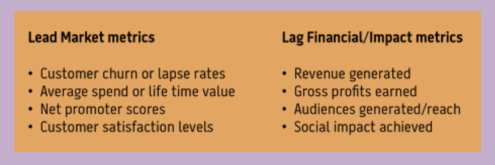
The list of marketing metrics goes on, and on, and on..
Why do we need marketing metrics?
To drive improvements on what we do and focus people and resources on what is important to us. Metrics help us be better. Metrics should support all aspects of all strategies on all levels and departments – finance, marketing, competition, standards and customer requirements/expectations.
How do we know how well we did? – compare the marketing metrics results to last month, last year, competitor data, industry data.
How do we know whether what we did is adequate? – We set a Key Performance Indicator (KPI). A KPI is a measurable value that indicates how effectively a company achieves their objective. Different departments have different metrics; combining the objectives leads to hitting the strategic business objective and setting a new objective for the next business milestone.
A KPI is part of a SMART objective, which is part of an overall business objective. The success of any objective is measured with KPIs.
For example, let’s say that a student is a start-up company, investing in a degree to achieve market-ready status in 3 years time. The main objective, then, is to graduate in 2020 with a 2:1 Hons degree from university. As an individual with a plan, you break down the remaining year into 4 semesters. Every semester your goal is to pass all 6 modules. For the first semester, you set a KPI of minimum 60% for each module. Anything below needs improvement, anything above 60% is good for the first semester. 2nd semester you have a target of 65% as benchmark. Create slow improvement of the overall 3-year target by dividing it into smaller, more meaningful short-term chunks.
Metrics that your CEO will love
If you know these metrics and how to measure them, you will be golden.
Customer Acquisition Cost, Customer Lifetime Value, Marketing originated customer, Return on Investment and Net Promoter Score are the main marketing metrics I have stumbled upon in my professional life. Metrics don’t change per industry, only numbers do.

Even when you brief agencies, you should add the measures of success of the project you brief. In that way, you will be able to conform the agency to your way of thinking and they will also be able to contribute to the metrics with numbers and even extra metrics!
What about measuring the brand?
For brand measurement, I have only used the Brand Development Index, Brand Penetration % and Net Promoter Scores. With measuring for example the share of voice online, there are plenty of digital tools and brands that can give you a score, similar to Klout. I personally prefer to do it the hard way – analyse the market players, get their details from Companies House, create a spreadsheet and measure against sales per brand. If anyone has a better way of measuring brand share, please feel free to share.
There are also plenty of dashboards that can show real-time brand and campaign metrics. Using dashboards can assist with improving the efficiency of a brand, campaign or sales real-time. You can always make your own dashboard in Excel; it is a bit of a pain at the start but, after you set everything up, you won’t need to do anything else apart from “Refresh”.
Net Promoter Score
I find NPS useful when I want to measure attitudes, behaviour and habits of the target market. Combining it with Google Alerts, Trends and Analytics, it can be a powerful tool for every marketer who appreciates their customers’ online behaviour. Tracking customer behaviour, though, is a hard thing to do and requires a lot of research. Even if you have qualitative data, you need to try and quantify them somehow – which is why I love using NPS and create tally reports on various behavioural KPIs.
Where do I find more information on metrics?
First and foremost, Google is your friend. Always and forever. I showcased to the class different books I use to cross reference metrics and data analysis, but as students are all pretty much Gen Z and their pc/tablet/mobile phone is the extension of their hand, I recommended Hubspot and Marketo, as well as Marketing Week and Ad Age as some of the blogs and magazines they need to be up-to-date with.
I was intrigued to see that only 2 students were using pen and pad; everyone else was using a laptop to take notes. That made me feel a bit old..! I am, however, glad I did the guest lecture. Not only because I am proud for the university that gave me the basis for my marketing profession, but also because when I was at uni – and even sometimes at work – I wished that there could be someone out there to show me in practice how to do analysis, measure a campaign or even answer my silly Excel questions!
Thank you for taking time to read my blog. Please feel free to comment below or send me a message directly on vdiamanti@gmail.com.
 violetdiamanti.com
Pingback: Building an agile strategic approach to digital marketing in 2020 | violetdiamanti.com