Micromanaging can occur in many forms, but most typically in higher level managers who dictate how mid management or other employees complete tasks, question employees’ judgements when their opinion differs, frequently ask for updates when tasks are not at the date of agreed completion, or check in incessantly. While the line between effective involved leadership and micromanaging can be thin – detail-oriented or obsessive? constructive or controlling? – there are many people like you and me who have felt the effects of a manager whose management style is more overbearing than hands-on and collaborative.
Micromanagement differs from mismanagement. As per Wikipedia, “Micromanagement can be distinguished from the mere tendency of a manager to perform duties assigned to a subordinate. When a manager can perform a worker’s job more efficiently than the worker can, the result is merely suboptimal management: although the company suffers lost opportunities because such managers would serve the company even better by doing their own job (see comparative advantage). In micromanagement, the manager not only tells a subordinate what to do but dictates that the job be done a certain way regardless of whether that way is the most effective or efficient one.”
So why can a boss micromanage you?
Apart from the obvious “power trip” – because they are your boss and they can – many bosses feel the need to monitor efficiency, or to keep things on track, especially if employees have erred in the past. Saying that, in my humble opinion and experience until now, most micromanagers do so out of a need for control that often has more to do with them than the performance of an employee; maybe it is their own feeling of fear of failure, job insecurity or that’s how they were managed before and they don’t know better. There is also the possibility that they think they are being helpful by hyper-controlling projects and people, which can happen in a more laid-back micromanaging structure (if it exists!). Or, there is a combination of all of the above, with a controlling personality in and out of work being the cherry on the top of your working cake.
Bosses range from autocratic behaviours to fully democratic ones. I identified 7 stages between “bossy” and “democratic” management from my past experiences and created the below infographic:
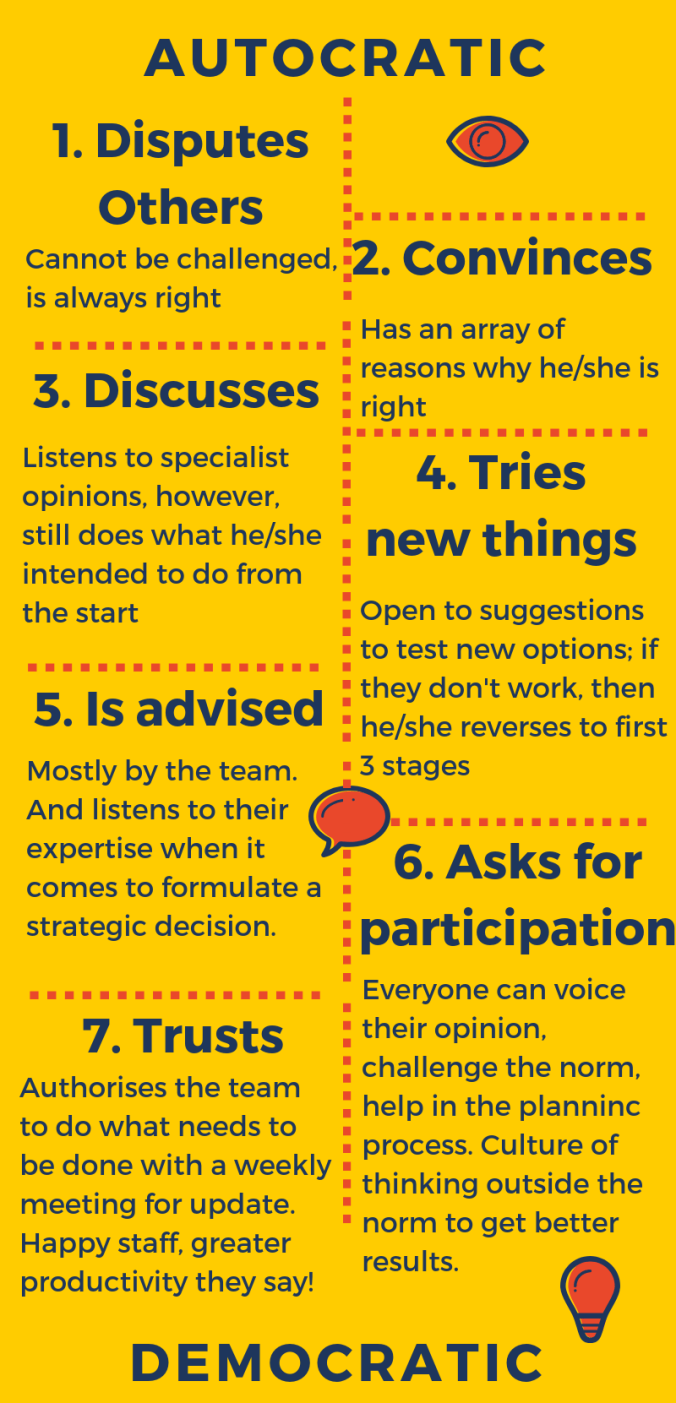
Micromanaging boss: 7 stages of micromanagement
Most of the bosses I had, who I will not name for obvious reasons, were usually between stage 1-3 and few times stretched to a 4. I had a boss a couple of years ago that was a mixture of stage 1 and 3 and hindered the success of the full team. Within 2 years, he lost 4 product managers due to non productive behaviour. A couple of months after I left that company, the head of PM was made to step down by the Board due to the numerous complaints received and never resolved. High staff turnover is a hindrance to every organisation’s bottom line and it is usually a manager/director to be blamed for it. People leave managers, not jobs.
My favourite boss was between stages 5 and 6, which made me feel like I was able to do the job right. No lengthy folder filing processes to track work on the PC (Trello and Asana are great tools for a non-IT specific filing system), not too many cooks to cook the projects and spoil or delay it, always fighting the PM corner and always there to listen. I was able to go speak to him about my ideas and how they can fit within the overarching organisational strategy.
Have I ever micromanaged my team in the past?
The answer is yes. All managers when they start managing teams want to ensure their success, not only on a personal but also on a team level. Everything should be running smoothly, from projects to interpersonal relationships between the members of the team and other departments. I had at times the tendency to ask for updates on specific projects only because I was thinking I could be of help to the team. This behaviour derived from my first experience in managing teams some years ago. I had a newbie to manage and help with the comms execution of 15,000 products and he failed the project. The issue was that I went straight to stage 7 (trust), whereas I should have been between stage 3 and 4. This means I should have planned mandatory weekly meetings to discuss what needs to be done, check the progress in weekly meetings and, if we had time, try new things to identify the employee’s working style.
Have I changed my style the past 3 years of managing teams?
The answer is also a big, fat yes. Seeing what I have done in the past as a manager and combining how I liked being managed and my vision of myself being a manager, I have improved my managing techniques and I am focusing on stages 5, 6 and 7. Nevermind the position people are at, we are all humans and we make mistakes. Some people communicate better than others, some like to be left at their own devises to crack on with their job. No-one wants to be made feel stupid, wrong, unworthy of their position within the team – people can always improve.
Micromanaging bosses (and directors, too) see their staff leaving one by one because of the suffocation and the never ending lack of appreciation. Treat people however you would like to be treated and give them space to breathe. You will be surprised what results trust yields.
Thank you for reading my blog. I welcome all comments so please either leave a comment below or, alternative, email me on vdiamanti@gmail.com .I will be more than glad to read your feedback.
 violetdiamanti.com